Introduction To Grand Ayatollah Ali Khamenei

Hojatoleslam Seyed Ali Khamenei Khamenei was one of the founders of the Islamic Republican Party, which dominated the Majlis (the national legislature) after the 1979 revolution. He was appointed to the Council of the Islamic Revolution in 1979, and between 1979 and 1981 he was a member of the Majlis, serving as deputy minister of defense, commander of the Revolutionary Guard, and representative on the Supreme Council of Defense. He also served several times as general secretary of the Islamic Republic Party.

After Imam Khomeini's demise, Ayatollah Seyed Ali Khamenei was elected the leader of the Islamic Republic of Iran by the Assembly of Experts, and when Ayatollah Araki passed away, he was introduced as Marja-e Taqlid (religious authority followed as source of imitation) by the Qom Theological School.

Ayatollah Khamenei was appointed a member of the Revolution's Council in 1979, and after the formation of the Islamic government in Iran, he became the representative of the Council in the army and the deputy for revolutionary affairs, and finally, the commander of the Islamic Revolution's Guards Corps (IRGC).

Imam Khomeini appointed him in 1980 to be the leader of the Friday congregational prayers in Tehran. He was also elected as a deputy of the Islamic Consultative Assembly (Majlis) in the same year. In the summer of 1981, after delivering an important speech in the Majlis which led to the dismissal of the then President Abolhassan Bani-Sadr, an attempt was made on his life by the Munafeqin (Mujahedin Khalq Organization) while making a speech in a mosque in a poor district of Tehran, and his chest and hand were badly injured.

On 30 August 1981, President Rajai and his prime minister were killed in a bombing. Following Mohammad Rajaee's martyrdom in 1981, in October 1981 Ayatollah Khamenei was elected president of the Islamic Republic with 95% of the votes cast in his favor.

He was president for another four years. During this time, he was chairman of the Supreme Defense Council and the Supreme Cultural Revolution Council. He toured and inspected the war fronts in the course of the (Iraqi) imposed war. On June 1989, on the morrow of Imam Khomeini's demise, he was elected leader of the Islamic Revolution by the majority of votes of the Assembly of Experts. After Ayatollah Araki's death, Ayatollah Khamenei was nominated as one of the sources of imitation by the faculty of the Qom Theological School.

On the departure of Imam Khomeini, more than 70 leading ulema in Iran declared Ayatollah Khamenei as being qualified for issuing fatwa on 'ifta' on controversial or complex points of points of religion.

In late 1994 there was a global campaign to encourage the faithful to emulate Iran's Grand Ayatollah Ali Khamenei as the top Shia authority worldwide -- marja-e-taqlid, the highest source of emulation. Following the demise of Grand Ayatollah Sheikh Mohammad Ali Araki, the initiative from the Society of Teachers of Qom Theological Seminary provided the names of senior ulama competent and qualified for marja'iat. These nominees were Ayatollah Seyed Ali Khamenei, Ayatollah Fazel Lankarani, Ayatollah Behjat, Ayatollah Vahid Khorasani, Ayatollah Mirza Javad Aqa Tabrizi, Ayatollah Musa Shubayri Zanjani, Ayatollah Makarem Shirazi. The society concluded that, compared with other countries, the marja' taqlid in Iran was least likely to be subjected to government pressure. Many Shias prefer a marja' who is not only a jurisprudent, but also well-versed in global politics, economics, and social issues. The final choice of the marja'iat is up to the people, and the world Shias made the ultimate decision. Many individuals and groups expressed support for Grand Ayatollah Seyyed Ali Khamenei, and so he had the highest number of muqallidin (followers). By December 1994 the move by the scholars of qom seminary and members of the Association of Combatant Ulema introduced Grand Ayatollah Ali Khamenei as the marja' taqlid of the world's shia community. In choosing Ayatollah Khamenei as the grand marja', the union of spiritual authority and political leadership could be effected. Once chosen as the grand marja', his supporters urged upon the Shia community to obey his commands and abide by his edicts in all temporal and ecclesiastical affairs.

Theoretically, the Islamic republic system (vilayat-i faqih, leadership of the supreme jurisprudent) is legitimate when a grand ayatollah who is recognized as a source of emulation (marja-yi taqlid) serves as the faqih (jurisprudent). Grand Ayatollah Mohammad Shirazi, like many others, did not accept Supreme Leader Ayatollah Ali Khamenei as a source of emulation. According to "Human Rights in Iran" (2001) by Pace University's Reza Afshari, Shirazi was "indignant" over Khamenei's efforts to be recognized as the supreme leader and as a source of emulation. Shirazi [who died in late 2001] apparently favored a committee of grand ayatollahs to lead the country. Shirazi was not the only senior cleric to suffer for questioning the legitimacy of Iran's political set-up and its leading figure. One of the best-known dissident clerics is Grand Ayatollah Hussein Ali Montazeri-Najafabadi. Others are Grand Ayatollah Hassan Tabatabai-Qomi and Grand Ayatollah Yasubedin Rastegari.

Ayatollah Khamenei is married and has six children. He is conversant with Arabic and Turkish, and knows English to some extent. He is a writer, is well-versed with poetry and literature, and has written 37 books to date.

Ayatullah Haajj Sayyid Ali Khamenei is the son of the late Ayatullah Sayyid Jawad Husaini Khamenei. He was born in Mashhad on the 17th of July 1939, which coincides with the 28th of Safar 1358 Hijri Qamari (lunar year). He was the second son of his parents, born into the house of Sayyid Jawad who lived a very simple life, like many of the scholars of his time, and it was from him that the family learned to live in a humble manner.

Remembering his life in his father’s home Ayatullah Khamenei says:

“My father was a well known religious scholar who was very pious and a bit of a recluse. We had a difficult life. I remember that sometimes at night we didn’t have anything in the house for dinner. Nevertheless my mother would try to scrape something up and that dinner would be bread- and-raisins.”

“My father’s house - the one that I was born in and lived until about the age of four or five - was about a sixty to seventy square meter home located in the poor area of Mashhad. The house only had one room and a gloomy basement. Whenever a guest came to see my father - his idea was that a religious scholar’s home is a place where people come to seek help - we had to go to the basement until they left. Some years later a group of people who were very inclined to and friendly with my father bought a small empty lot beside our house so that he could build onto the house, and so we ended up with a three room house.”

The Leader of the Islamic Revolution grew up poor but religious, and as his father was a pious and sincere religious scholar he was trained accordingly. At the age of four, along with his older brother Sayyid Muhammad, he was sent to an old fashioned school (Maktab) to learn the alphabets and Qur’an. Hence the two brothers were enrolled into a newly established Islamic school named Dar al- Ta`leem Diyanat, where the completed their primary studies.


The Islamic Seminary


During his time in high school he studied the book Jam e` al- Muqaddamaat, whereupon he began his studies in Arabic grammar. Later, after high school, he transferred to seminary studies and was taught Arabic grammar and other primary seminary studies by his father and other religious scholars of the time. Reflecting upon his reason for taking this path - the path of a religious scholar, Ayatullah Khamenei said:

“The factor which inspired me to choose the enlightened path of a religious scholar was my father; my mother also encouraged me (to choose this path), as she was very fond of the idea.”

Ayatullah Khamenei studied books such as Jame` al-Muqaddamaat, Suyuti, and Mughni in the Sulayman Khan Madrasah [religious school] and the Nawwab Madrasah in addition to his father’s supervision. He also studied the book Mu`alim while attending those schools. Later he studied Sharai` al-Islam and Sharh Lum`ah with his father, and a part of the second book with the late Aqah Mirza Mudarris Yazdi. He studied Rasa’el and Makasib with the late hajj Sheikh Hashim Qazwini and the remaining intermediate level studies jurisprudence and its principles (fiqh and usul) with his father. In this manner he finished the intermediate level of studies in an unprecedented of and zealous fashion within five and a half years. Moreover, his father the late Sayyid Jawad played an important role in the progress of his son.

In the fields of Logic and philosophy, The Grand Leader of the Islamic Revolution, Ayatullah Khamenei, begin his studies of the Manzumah of Sabziwari under the late Ayatullah Mirza Jawad Aqah Tehrani and later he completed that book under the late Sheikh Ridha Aysi.


The Islamic Seminary of Najaf


At the age of eighteen, Ayatullah Khamenei began studying the highest level - Darsi Kharij - of jurisprudence and its principles under the late grand Marja` Ayatullah al-Uzma Milani in Mashhad. In 1957 with the intention of visiting the majestic holy places he left for Najaf. Upon observing the situation in Najaf and attending the lessons Darsi kharij of the late Sayyid Muhsin Hakim, Sayyid Mahmud Shahrudi, Mirza Baqir Zanjani, Sayyid Yahya Yazdi, and Mirza Hasan Bujnurdi he decided to remain in the Islamic seminary of Najaf; however, his father did not accept this decision and thus after a short period he returned to Iran.


The Islamic Seminary of Qom


From 1958 until 1964 Ayatullah Khamenei continued his higher level studies in jurisprudence, and philosophy in the Islamic seminary of Qom. There he sat at the feet of grand teachers such as the late Ayatullah al-Uzma Burujerdi, Imam Khomeini, Sheikh Murtadha Hae’ri Yazdi, and `Allama Tabataba’i. In 1343, through a series of letters from his father, the Supreme Leader of the Islamic Revolution became aware that his father had become blind in one eye because of a cataract; this gave him a dilemma as to whether to stay on in Qom and continue his studies or to return to Mashhad and take care of his father. He, later came to the decision for Allah’s sake, to leave Qom and return to Mashhad to care for his father, in remembrance of this event he says:

“When I returned to Mashhad Allah blessed me as I took care of my affairs. If I have been successful in life, I believe that it all stems from this good deed that I did for my father; indeed, for both my father and mother.”

Ayatullah Khamenei selected the better of the two choices, although some of his teachers and friends expressed remorse as to his leaving the Islamic seminary of Qom; they predicted that he would have had a bright future had he stayed. Nevertheless, the future clearly showed that he made the right choice, as his destiny had something better in store for him - more than what his teachers did and friends could imagine. Could anyone have imagined that a young capable scholar at the age of 25 years old would leave Qom for the pleasure of Allah to care for his father and mother, and 25 years later would hold the grand office of Wali Amru’l- Muslimin [The Guardian of Muslim Affairs].

While in Mashhad he did not leave his studies all together. Rather, he continued his lessons in jurisprudence and its principles under grand teachers such as Ayatullah Milani until 1968 - only interrupting his lessons on holidays, to do political activity, while in jail or to travel. From the time he had returned to Mashhad in 1964, while caring for his parents he would also teach jurisprudence and its principles and other religious subjects to young seminary and university students.


Political Activism


Ayatullah Khamenei in his own words is one of the students of Imam Khomeini in the areas of jurisprudence and its principles, and in revolutionary and political ideas. However, the first spark of his political activism and hatred for oppression was inspired by the great revolutionist and Martyr Sayyid Mujtaba Nawwab Safawi. It was in the year 1952 that Nawwab Safawi and some of his supporters went to Mashhad to the Sulayman Khan Madrasah. There he delivered a dynamic lecture on reviving Islam and its Divine Rule and he warned the Iranian people of the deceitful lies of the Shah and the English government. At the time, Ayatullah Khamenei was one of the young students of the Sulayman Khan Madrasah who attended the fiery speech of Nawwab Safawi and he was very much influenced by the great revolutionist. Ayatullah Khamenei remembers that moment, saying:

“It was at that very moment, because of Nawwab Safawi that the consciousness of Islamic Revolutionary activism sparked inside me. I have no doubt that it Nawwab Safawi who first kindled the fire (of revolutionary Islam) in my heart.”


Partaking in Imam khomeini’s Movement.


In 1962 while Ayatullah Khamenei was still in Qom he joined the revolutionary Movement of Imam Khomeini, which opposed the pro-American, anti-Islamic politics of Muhammad Reza Shah. Despite all the ups and downs, persecutions, exiles, and imprisonment Ayatullah Khamenei fearlessly continued on this path for sixteen years.

In Moharram 1383 Hijri Qamari [May 1963], for the first time, Ayatullah Khamenei was sent on a mission by Imam Khomeini. This mission was to communicate the Imam’s message to Ayatullah Milani and other clergymen in Khorasan. This message was to set the tone for the propagation and exposure of the pro-American policies of Muhammad Reza Shah in the month of Moharram.

Ayatullah Khamenei fulfilled this mission and also acted upon its demands, as he was sent to Birjand for propagation in Muharram. As a result of his propagation on the ninth of Moharram (June, 2, 1963) he was arrested. He spent one night in jail and freed only under the condition that he would never return to the pulpit (minbar) to speak again. From that moment on he knew that he would be under police surveillance. Upon the development of the bloody incident of ‘The Fifteenth of Khordad’, Ayatullah Khamenei was taken into custody in Birjand , and then transferred to a prison in Mashhad where he spent ten days under severe torture before being released.


The Second Imprisonment


In January 1964 - i.e. Ramadhan 1383 according to a well-organized plan, Ayatullah Khamenei and some of his friends left for Kerman. After two or three days of preaching and visiting religious scholars and students in Kerman they departed for Zahedan. Their preaching and their emphatic way of exposing the Shah’s hypocritical referendum was well accepted among the masses, especially on the 6th of January when it was election time. On the fifteenth of Ramadhan, the birthday of Imam al-Hasan (peace be upon him), his diligent preaching and public disclosure of the satanic, American politics of the Pahlavi Dynasty reached its peak. As a result of this, Savak [The Shah’s intelligence Agency] came and arrested him in the night - that night they took him by airplane to Tehran. The grand leader spent about two months in solitary confinement bearing various types of tortures.


The Third and Fourth Imprisonment


The lessons he held on exegesis of the Qur’an, prophetic, and Islamic ideology in Mashhad and Tehran were warmly welcomed by revolutionary - minded youth. Because of this Savak began to keep a close surveillance on Ayatullah Khamenei. In the year 1967 Ayatullah Khamenei was forced to live underground, but exactly one-year later he was captured by Savak and imprisoned. In the year 1371 he was again arrested by Savak for the very same activities for - holding classes and conducting enlightening, intellectual discussions.


The Fifth Arrest


Ayatullah Khamenei writes about his fifth apprehension by Savak, saying:

“From the year 1348 [1970] the situation was ripening for an armed revolution in Iran. The sensitivity and severity of the former regime against me had increased. Because of the circumstances they were no longer able to ignore people such as myself. In 1350 [1972] I was again taken to prison, for the fifth time. The harsh attitude of Savak indicated that the System (regime) was very afraid of an armed revolution being accompanied with a sound Islamic ideology. They could no longer believe that my intellectual activism and propagation in Mashhad and Tehran had nothing to do with the developing situation. After being released, the attendance at my open classes on the exegesis of the Qur’an and private classes on ideology and other subjects increased.“


The Sixth Arrest


Between the years 1972 and 1975 Ayatullah Khamenei’s lessons on the exegesis of the Qur'an and Islamic ideology were now being held in three Masajids - karaamat, Imam Hasan (a.s.) and Mirza Ja`far - in the holy city of Mashhad. Thousands of people attended these lessons, especially conscious - minded youth and politically - active students.

His lectures on the Nahjul Balaqa offered another type of experience in a different way. These lectures were transcribed and published in a circular named ‘Poly copy’ under the title ‘The Glorious Nahjul al-Balaqah’. The young revolutionary minded students who were taught the reality and true meaning of struggle by Ayatullah Khamenei were very diligent in spreading this ideology to the masses in nearby cities. This action cause Savak to break into his home in Mashhad in the winter of 1975 arresting him and confiscating many of his notes and other writings. This was the sixth and most difficult imprisonment in Ayatullah Khamenei’s life. He was detained in the central prison of Iran until the fall of 1976 under the most stringent conditions. Ayatullah Khamenei describes the severity of the condition of that prison saying, “such conditions only made sense to those people.”

After being released from prison Ayatullah Khamenei returned to Mashhad where he continued his political / revolutionary activities although he was not able to reestablish his classes as they were before.


In Exile


The illegitimate Pahlavi regime in the latter part of the year 1976 apprehended Ayatullah Khamenei and sentenced him to exile in Iranshahr for a period of three years. By mid 1979, during the climax of civil unrest in Iran, he returned to Mashhad where he confronted the bloodthirsty Pahlavi regime. Fifteen years later after bearing all the harsh and bitter moments of the Islamic revolution, Ayatullah Khamenei witnessed the fall of tyrannical Pahlavi regime and the establishment of the Islamic Republic.


On the Threshold of Victory


On the brink of victory for the Islamic revolution - before the advent of Imam Khomeini’s return to Iran from Paris - an Islamic Revolutionary Council was formed by the Imam. This counsel consisted of important personalities such as Shaheed Muttahari, Shaheed Beheshti, and Hashemi Rafsanjani. Ayatullah Khamenei’s upon Imam Khomeini’ decree became a member of this counsel. Thereupon, after receiving this message through Shaheed Muttahari, Ayatullah Khamenei left Mashhad and went to Tehran.

After the Victory

After the victory of the Islamic Revolution Ayatullah Khamenei continued to be very active in working for Islam and fulfilling the goals of the Islamic revolution. The tasks that he performed in those times and until now are unparalleled and without an equal, however though in this brief biography we can only mention the most important of these tasks. A chronological list of Ayatullah Khamenei’s services to the Islamic Republic of Iran after the victory of the Islamic revolution is as follows:
February 1979 - One of the founders of the Islamic Republic party along with like-minded scholar such as Shaheed Beheshti, Shaheed Bahunar, Musawi Ardebili, and Hashemi Rafsanjani.
1980 - Secretary of Defense.
1980 - Supervisor of the Islamic Revolutionary Guards.
1980 - Leader of the Friday Congregational Prayer.
1980 - The Tehran Representative in the Consultative Assembly.
1981 - Imam Khomeini’s Representative in the High Security Council.
1981 - Actively presents at the war front during the imposed war between Iran and Iraq.
1982 - Assassination attempt by the hypocrites on his life in the Abuthar masjid in Tehran.
1982 - Elected President of the Islamic Republic of Iran after martyrdom of Shaheed Muahmmad Ali Raja’i. This was his first term in office; all together he served two terms in office, which lasted until 1990.
1982 - chairman of the High Council of Revolution Culture Affairs.
1988 - President of the Expedience Council.
1990 - Chairman of the Constitution Revisal Comity.
1990 - Ayatullah Khamenei became the Supreme Leader of the Islamic Republic of Iran by choice of the Council of Experts, after the demise of Imam Khomeini.


Written work

His Writings and Research Work:
1- A Complete Overview of Islamic Thought in the Qur’an.
2- The Profundity of Prayer.
3- A Discourse on Patience.
4- The Four Major Book Concerning the Biographic of Traditionalist.
5- Wilaayat - Guardianship
6- A Glimpse at the History and Previous State of the Islamic Seminary of Mashhad.
7- A Biography of the Shi’ite Imams (Peace be upon them).
8- Imam Saadiq (Peace be upon him).
7- Unity and Political Parties.
8- Art in the Viewpoint of Ayatullah Khamenei.
9- Understanding Islam Correctly.
10- The Discourse of Wilaayat.

Translations (from Arabic to Persian):
1- The Peace treaty of Imam Hasan (Peace be upon him).
2- The Future from an Islamic perspective.
3- Muslims in the Liberation of India.
4- Petition Against the Western Civilization


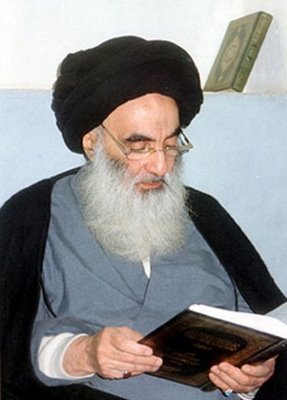
Introduction To Grand Ayatollah  Sistani

Biography

1- His Birth and Upbringing
2- His Scientific Genius
3- His works
4- His Methodology in Research & Teaching
5- Sistani's Personality
6- The Religious Authority

For more than half a century, the school of the late Ayatullah Uzma Khou'i has been a clear source for many scholars who have been graduated from this school and later on became eminent `alims. One of the most eminent among students of the Late Ayatullah Khou'i is Ayatullah Sayyid Ali Husayni Sistani, who is known for his genius, knowledge, and talent. Hereby, we shall try to tell a brief account about the biography of this remarkable personality:

1- His Birth and Upbringing :


Ayatullah Sayyid Ali Husayni Sistani was born in Rabi`ul Awwal 1349 A.H. (1930 A.D.) in Mashhad, into a family known for its religious background. He learned Arabic literature and rhetoric. While he learned theological and rational sciences from many eminent and well-known religious scholars in Khuraasaan. Ayatullah Sistani attended many lectures on Kharij stage and benefitted from the knowledge (Post Doctrate level) of Allamah Muhaqqiq Mirza Mahdi Isfahani. He also benefited from the knowledge of `Allamah Mirza Mehdi Isfahani. After that, in 1948, Sistani traveled to Qum in the lifetime of the late Ayatullah Boroujerdi, and began studying in its seminary. He could have lots of knowledge from the late Ayatullah Boroujerdi, especially on Usoul and Fiqh, and he agreed with almost all of his points of view. There, he attended lectures of Ayatullah Hujjat Kouhkamar'i too. Being thirsty to take some other sips of religious study, Sistani migrated to Najaf in 1951, and could attend some lectures of Ayatullah Hakeem, shaykh Husayn Hilli, and the late Ayatullah Khou'i. In particular, he attended the lectures of Ayatullah Khou'i on Fiqh and Usoul for more than ten years. Sistani also finished a complete series of lessons on Usoul which he learned from Ayatullah Shaykh Husayn Hilli. In the meanwhile, and exactly from 1948 up to now, Ayatullah Sistani was teaching Kharij stage (based on the book titled "al-Makaasib" by Shaykh Ansaari). He also teaches the book of Tahaara (purity) and many parts of Prayers' book besides a part of the book of Khumus (the one-fifth tax). In 1964, Ayatullah Sistani began teaching the Kharij stage on Usoul, and until the year 1990 he could accomplish three series of lectures on the same subject.

2- His Scientific Genius:


Ayatullah Sistani is one of a few students who had the degree of Ijtihad.
He is known for his intelligence and plentiful researching activities in biographies. He is also well-acquainted with many theories on many scientific subjects of hauzah. Ayatullah Sistani had been involved in scientific competition with martyr Muhammad Baqir Sadr. This had been certificated by the late Ayatullah Khou'i and also by `Allamah shaykh Husayn Hilli who both had confirmed his being a Mujtahid through two separate certification dated 1960, in which the two Ayatullahs had appreciated his personality and knowledge. It is worthy to say that up to that date, Ayatullah Khou'i had never certificated any of his students' knowledge or Ijtihad, except for Ayatullah Sistani and Ayatullah shaykh Ali Falsafi (an eminent `alim in the hauzah of Mashhad. On the other hand, the famous `Allamah shaykh Agha Buzurg Tehrani wrote a letter to Ayatullah Sistani in 1960 in which he eulogizing him for his intellectual talents on biography and hadith. This means that, Ayatullah Sistani, had been granted his high scientific rank when he was only thirty-one years old.

3- His works:


Ayatullah Sistani began teaching the Kharij stage on Fiqh, Usoul, and biography 34 years ago. He held many lectures about the book titled as "makaasib", and many subjects sucH as purity, prayers, judgment, khumus, and some other rules on Fiqh like sury, Taqiyyah (precaution), and the rule known as "Ilzam" (obligation). Sistani also taught the Usoul for three complete courses, some of which are ready for publication, like his research on the scientific roots (principles), "Ta'adul and Taraajeeh", some researches on Fiqh, some chapters about prayers, the rule of Taqiyyah and Ilzam. Many eminent scholars, such as `Allamah Shaykh Mahdi Murwaarid, `Allamah Sayyid Habib Husaynan, `Allamah Sayyid Murtaza Isfahani, `Allamah Sayyid Ahmad Madad, `Allamah Shaykh Baqir Irwaani, and many other teachers in the hauzah, have recorded his researches. During that, Ayatullah Sistani was busy in compiling important books and some treatises, in addition to what he had written on Fiqh and Usoul. Hereunder, are some of Ayatullah Sistani's books and treatises:


1- Explanation on "al-`Urwatul-Wathqah".
2- Researches on Usoul.
3- The book of Qaza'ah' (judgment).
4- The book of Sale and Choices.
5- A treatise on doubtful clothes.
6- A treatise on the rule of "Yad" (hand).
7- A treatise on the traveller's prayers.
8- A treatise on the rule of "tajaawuz" & "Faraagh".
9- A treatise on "Qiblah".
10-A treatise on "Taqiyyah" (precaution).
11-A treatise on the rule of "Ilzam" (obligation).
12-A treatise on ijtihad & imitation.
13-A treatise on the rule of "La zarar wa la ziraar".
14-A treatise on Usury.
15-A treatise on that the correspondence of Ibn-e-abi `Umayr is reliable.
16-A criticize on the treatise titled "The correction of Chains" of Ardebeeli.
17-An explanation on the book titled "Mashyakhat ul-Tahthibayn".
18-A treatise on the past methods in regard to the reliable narrations. With many other handwritten compilations and treatises on rules for the imitators.

4- His Methodology in Research & Teaching:


Ayatullah Uzma Sistani has his own method of teaching which differs from other teachers and scholars. For example, his method in teaching Usoul distinguishes with the following features:

He speaks about the history of the research he is discussing, to know its fundamental sources which might be philosophical, like the issue of the simplicity of "mushtaqq" and its constructions. Or, they might be concerned with beliefs and policy, like the research of "Ta'aduland Traajeeh", in which he had explained that the difference of hadiths returns to intellectual clashes and the political circumstances of that time during which the Imams(a.s.) had lived.

Ayatullah Sistani always connects between the thought of Hauzah and the contemporary civilizations. In his discussing the literal meaning and distinguishing between it and the highest meaning, and whether this difference is subjective or not; Ayatullah Sistani chooses the thought of al-Kifaya's author, who believes that the said difference is external. However, he himself builds his opinion on the modern philosophical theory. And when he discusses the name of TIME, he deals with this subject according to a Western modern philosophical theory, which declares that TIME must be taken from PLACE, having the consequence of light and darkness. As to the form of imperative, Ayatullah Sistani discusses this matter depending on some sociologists' theories, which say that the reason behind dividing the REQUEST into: Order, Begging, and Asking, is the intercession of the requester in his Request, as whether it is of higher, equal or lower than the normal level.

Ayatullah Sistani always looks after the principles in relation with Fiqh. He thinks that the hauzah students became bored because most of scholars are dealing with subjects on Usoul exaggeratedly, by repeating the others researches, instead of innovating new researches of their own. Thus, the students cannot be enticed with such unuseful and boring repetition. But fortunately, we do not find this situation in the lectures or lessons that are being held by Ayatullah sistani. He rather, discusses the subject from all its sides until he reaches a final logical conclusion.

The Marriage to the Infidel: This is one of the disputatious rules about which the scholars have different opinions. They believe that it is a mere intellectual rule. But Ayatullah Sistani regards it as a part of the rule called "Iztiraar" (obligation) which is a legal rule confirmed by many historical texts like "Anything which Allah has prohibited is lawful for whoever is driven to necessity". Or sometimes, he amplifies a rule by emphasizing what is seems to be important.

His Social View About the Text: There are many Faqihs who deal literally with historical texts and remain stable upon their mere words and meanings, and do not try to move even one step forward. For instance, such faqihs depend on the apparent meaning of the prophetic hadith in which the Holy Prophet(s.a.) had prohibited the Muslims from eating the meat of domestic asses during the time of the battle of Khaybar, and believe that the asses' meat is prohibited, without objection. But, from the Ayatullah Sistani's point of view, faqihs must penetrate into the real meaning behind the text's words. He says that the Holy Prophet, and for sure, wanted to utilize the few number of asses the Muslims have in the best and most useful ways. One of those ways is that these asses must be kept alive to convey the arms and other important provision to the Muslim army, since they were the only means available for transportation. Thus, Ayatullah Sistani believes that the prohibition must have been temporary and must not be understood as absolute a permanent one.

Experience & Acquaintance: Ayatullah Uzma Sistani believes strongly that a faqih must be acquainted with Arabic literature, civilization, orations, poems, grammar,...etc., otherwise he wouldn't have enough ability to deal with any text, and so, he cannot distinguish this meaning from that. And, also a faqih must have enough knowledge about historical biographies and dignities, in order to be able to recognize any text in relation to that personality. Moreover, it is amazing to mention here, that Ayatullah Sistani, and in many occasions, disagrees with rules that are unanimously agreed by most of scholars. As an example, the Ulama do not accept Ibnul-faga'iri's criticism book in regard to some personalities, either, as they believe, because of the huge number of criticism he had against those personalities, or because they doubt his being the author of the book. While Ayatullah Sistani believes that Ibnul-faga'iri's is the real author of that book, and that he must be regarded more reliable than even Najjaashi, ash-Shaykh, and others, for his criticism. Ayatullah Sistani always encourages the scholars to study the different copies of hadith, and distinguish between them to fetch the differences, and also study the biography of the narrators. He does agree with those who regard al-Sadouq more reliable (in narrating traditions) than al-Shaykh. He rather believes that al-Shaykh is trustworthy enough. However, Ayatullah Sistani and martyr Sadr both try to give a new formation to the subject. Now, when Ayatullah Sistani discusses the rule of "ta`aadul and taraajeeh", he refers to the secret concealed inside this rule, which is the reason of the hadiths' difference. So, if the scholars attempt to point the reasons of the difference behind the legal texts, there will be no problem at all. The same subject had been discussed by martyr Sadr, but he had dealt with it according to the absolute intellection, while Ayatullah Sistani gave many temporary and historical evidences, until he got important rules through which many disputes have been solved and removed. It is said that Ayatullah Sistani is using this method in the Fiqh lessons he is holding.

Comparing between different schools: Commonly, many scholars try to constrict their researches to this religious school or that, but Ayatullah Sistani differs. He always compares his research or discussion with the two main centers of knowledge, namely the hauzah of Mashhad and the hauzah of Qum on the one hand, and the hauzah of Najaf on the other hand. For instance, he conveys the opinions of Mirza Mahdi Isfahani (one of the scholars of Mashhad), Boroujerdi (an `alim from Qum), and the opinions of the three researchers, Ayatullah Khou'i, and Shaykh Hasan Hilli (as scholars from Najaf). The Sistani's method in Fiqh has a particular feature, some of which are related herebelow: 1) Comparing between the Fiqh of Shia and other Islamic sects' Fiqh. 2) Benefitting from the modern laws (like the Iraqi, Egyptian, and French laws) in some Fiqh subjects, especially when he discusses the subjects such as the Sale and the Choices. 3) Renewal in Discussing some Fiqh rules and according to this era's circumstances, contrary to some scholars who deal with the historical texts as they are without attempting to change any part of it as the conditions may request that.

5- Sistani's Personality:


Whoever associates with Ayatullah Sistani, he will notice how high spirituality he earns, the spirituality that Ahlul Bayt(a.s.) have always called to. This feature, indeed, has rendered him one of high rank's scholars and a true pious. However, the most remarkable characteristics of Ayatullah Sistani are the following: a\ Equity and Respecting Others' Opinions: Because Ayatullah Sistani is fond of knowledge and always does his best to reach the truth, and also because he respects everybody's opinion and every objective point, he keeps reading and researching all the time. He is very anxious to know others' thought and discover the target points of his mates. Many times and in many occasions it is seem referring him to one of the scholar's opinion even this scholar is not one of his masters, or he is not very known in the hauzah, only because that opinion has an objective point (or points) of view. b\ Discussing Subjects Politely: It is known among the scholars that subjects and on many fields are being discussed roughly in the hauzah of Najaf. It is no doubt that such a manner may cultivate the students' knowledge and purify it from every incorrect understanding. However, the students quarrel about something un important, and thus, the same manner may be mere squabble. In this case, more precious time would be wasted in vain, and no one would reach the holy aim, which is certainty, for which he pays all that endeavor and exertion. On the other hand, it is seem that Ayatullah Sistani avoids disputes and void argumentation, or disregarding others' opinions and conclusions. He always tries to use polite phrases, and always does his best to keep the scholars' respect and veneration. Another feature, is that Ayatullah Sistani used to repeat his speech and phrases that consist important points; but if he noticed a continuous arrogance and obstinacy from a student, he then prefers silence. c\ Training Beside Education: Education is not only an official job through which a teacher may practise a routine work against his salary. Such a behaviour shall certainly deviate the teacher from the main target is to training his students. A teacher must be regarded his work as a heavenly mission which he must practise with love, care, and full responsibility. It is said that Ayatullah al-Hakim's high behaviours were Sistani's excellent model. He himself became a model of his master, the late Ayatullah Khou'i, and is treating his students exactly as the late Khou'i used to treat his students. Ayatullah Sistani, always encourages his students to ask and research, until they reach the truth. In the same time, he insists on respecting the scholars and `Ulama. d\ Piety: Sometimes, the hauzah undergoes problems or critical attitudes which, yet they are not to be faced bravely, many facts that affect the principles of the Islamic religion shall be concealed. There is no doubt that all `Ulama must stand with courage in front of these incorrect currents. But the same situation may rise because of personal enmity or competitions to reach a higher rank or hollow reputation. In this case, many `Alims, such as Ayatullah Sistani, prefer to stand aloof instead of participating in this dilemma, as happened after the demise of Ayatullah Boroujerdi and Ayatullah al-Hakim. Ayatullah Sistani is very well-known for his humble and simplicity in lifeway. He earns ordinary house and furniture, and wears unexpensive garments. He does not care about fashion or modern mode. e\ Sistani's Intellectual Works: Ayatullah Sistani is not a mere faqih; he is rather a well-educated personality. He is acquainted with most of contemporary knowledges and civilizations, and has modernized thoughts and opinions. Ayatullah Sistani is heedful of the international economic and political information. In one word, Ayatullah Sistani can be considered as a modern faqih with genuine principles.

6- The Religious Authority:


Some masters in Najaf-e-Ashraf relate that, after the demise of Ayatollah
Sayyid Nasrullah Mustanbit, many scholars had suggested on Ayatollah Khou'i that he should prepare the appropriate base by choosing a personality from the hauzah (of Najaf) so that the religious authority may remain alive and effective. His choice became correct and the choic was about Sayyid Sistani for his knowledge, good manner, stable policy, and many other virtues. Ayatollah Sistani then began to perform the prayers at the niche of Ayatollah Khou'i, and started studying in his school. Later on, he wrote a commentary on the Resaalah of Ayatollah Khou'i. After the death of Khou'i, Ayatollah Sistani was one of those six personalities who participated in the funeral and he himself performed the prayers on the late's body. After that, Sistani became the only marja` (religious authority). He began to send duties and salaries, and teaching in the same classroom of Ayatollah Khou'i (in Masjid Khazra'); thus, his followers increased day after another, especially in Iraq, the Persian Gulf region, India,...etc. Ayatollah Sistani has the highest rank among the mujtahids and scholars throughout the Islamic World, and especially in the hauzahs of Najaf-e-Ashraf and Qum.